
Institute for Earth Science Research and Education
2686 Overhill Drive
Eagleville, Pennsylvania 19403 USA
Phone: 610-584-5619
E-mail: brooksdr@instesre.org
 |
 |
 |  |
|
President Institute for Earth Science Research and Education 2686 Overhill Drive Eagleville, Pennsylvania 19403 USA Phone: 610-584-5619 E-mail: brooksdr@instesre.org |
Some of the work described on this site has been made possible by support from the National Science Foundation, the National Aeronautics and Space Administration, the National Oceanic & Atmospheric Administration, and the Toyota USA Foundation. Click here for policy statements concerning this website. |
|
| November 11, 2021, Wild cherries (Prunus avium?) 2023 was a banner year for fruit trees in our area. Thes wild cherries are from a a tree that hangs over our driveway. 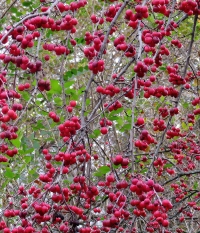 |
 | You can now use your PayPal account to purchase instruments from IESRE. |
|
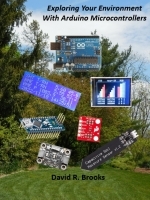
Exploring Your Environment with Arduino Microcontrollers David R. Brooks This 2023 book shows how to use Arduino microcontrollers to monitor the natural and manmade environment, with a focus on the opportunities and limitations associated with using Arduino-compatible sensors. HERE is a webpage that supports the book with updates and links to code and color versions of many of the book's figures. This webpage also includes links to other documents about using Arduinos. You can get this book directly from IESRE. All proceeds go toward supporting IESRE's mission. IESRE doesn't accept credit cards, but you can pay by check to Institute for Earth Science Research and Education at the address above, or by PayPal to brooksdr@instesre.org. The cost is $25 including shipping to any U.S. address. If you pay with Paypal, IESRE would appreciate it you could add an extra $2 to help with transaction fees. Thanks! |
 |

| This graph of barometric pressure recorded during Hurricane Irene in 2011 and "super storm" Sandy in 2012 dramatically illustrates the passage of these storms through our area. Many sites, including a small airport site near IESRE were not operational during the height of Sandy. Amazingly, we did not lose electrical power during either of these storms even though both storms resulted in widespread power losses – millions of people throughout the northeast lost power during Sandy. | 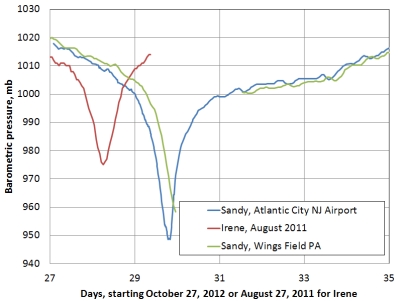 |
PDF versions of Brooks' PowerPoint presentations from June 2012 GLOBE/Europe-Eurasia Annual Meeting, Utrecht, The Netherlands:
• A History of Student Sun Photometry
• Student Pyranometry
• (for information about monitoring surface radiating temperature,
see this link.)
 My local weather and forecasts